FRAUD BASICS – UK GUIDE
The Fraud Triangle
Explained in Plain English
Every scam follows the same pattern. Once you see it, you can’t unsee it — and that’s how you stay one step ahead. The Fraud Triangle shows how pressure, opportunity and rationalisation combine to make fraud happen.
✅ Based on real UK scam patterns · ✅ Informed by NCSC & Action Fraud guidance · ✅ Works for texts, emails & calls
What Is the Fraud Triangle?
Every scam has the same three forces behind it — Pressure, Opportunity,
and Rationalisation. Together, they explain why good people make bad decisions under
stress.
Remove just one side of the triangle — and the fraud collapses.
Fear, stress or urgency — “Your account will close” or “Act now.” Scammers create false time pressure so you react, not think.
Fake links, cloned sites or spoofed calls create an easy opening to grab your details or money. They make the wrong action feel quick and simple.
The voice in your head that says “It’s only £1.99” or “They sounded official.” That’s how a scam feels normal — until it’s too late.
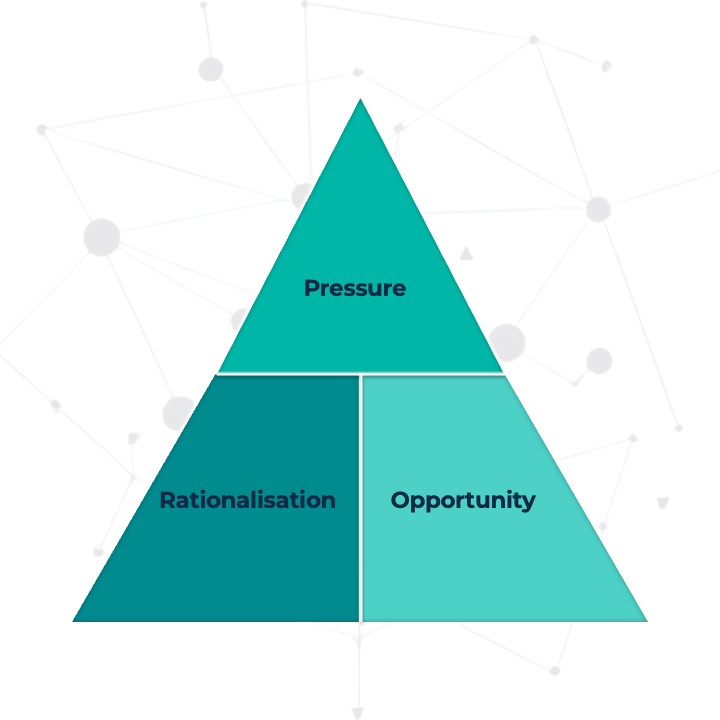
The Fraud Triangle Model
When pressure, opportunity and rationalisation line up,
almost any fraud becomes possible. Remove just one — and the triangle collapses.
- Pressure → urgency or financial stress.
- Opportunity → a way to act unseen.
- Rationalisation → the self-talk that makes it feel “okay.”
Examples of the Fraud Triangle in Action
Notice how pressure, opportunity and rationalisation show up in real messages. If you spot even one sign — pause and verify.
Pressure (urgent risk), opportunity (safe account), rationalisation (“we’re the fraud team”). They want a quick transfer or OTP.
Pressure (missed parcel), opportunity (quick payment link), rationalisation (tiny fee). The page looks real — the URL isn’t.
Pressure (urgent emergency), opportunity (private chat), rationalisation (“just this once”). Emotions first, money next.
- Pause for 10 seconds — break the fast-reaction trap.
- Scan for urgency, authority, and a push to pay/share/login.
- If one sign appears, verify independently before you act.
Resources (UK)
Trusted places to report, check, and get official guidance. External links open their websites.
Report fraud & cyber crime online. UK national reporting centre.
Forward phishing emails to the NCSC for analysis.
Send spam texts to 7726 (free) from your mobile provider.
Public campaign with simple advice to stop scams fast.
Make accounts safer: strong passwords, 2FA, device security.
Check investments and firms before you move money.
Learn More About Fraud Awareness
Explore our full series of guides on scams, fraud prevention, and red flags — all written in plain English.
Is the fraud triangle still relevant online?
Yes—methods change, drivers don’t.
Can caller ID be trusted?
No—numbers and names can be spoofed; always verify independently.
What if I already clicked a link?
Change passwords, call your bank, enable 2FA, forward texts to 7726, and report to Action Fraud.
Does training really help?
Yes—short habits dramatically reduce risk over time.
Explore more in our Fraud Basics series:
Resources (UK)
- Action Fraud — report fraud & cyber crime.
- Text 7726 link: 7726 — forward spam texts.
- Take Five to Stop Fraud — official advice.
- NCSC Cyber Aware — device and account security.
- FCA ScamSmart — check investments and firms.
- Your bank’s security page — how to report and what they’ll never do.
📘 Get our Free PDF: Spot Scams in 10 Seconds
Use 10 quick checks you can rely on for texts, emails, and phone calls.
Get My Free GuideNo spam. Practical tips only.
Report it fast: Every text or email reported helps block the next scam.
📱 Forward to 7726 (free) ✉️ report@phishing.gov.uk